

Why are so many AI-generated websites starting to look the same?
AI can build a website in minutes. But if everyone is using the same tools, are we all starting to look alike?
There's something interesting happening in web design at the moment.
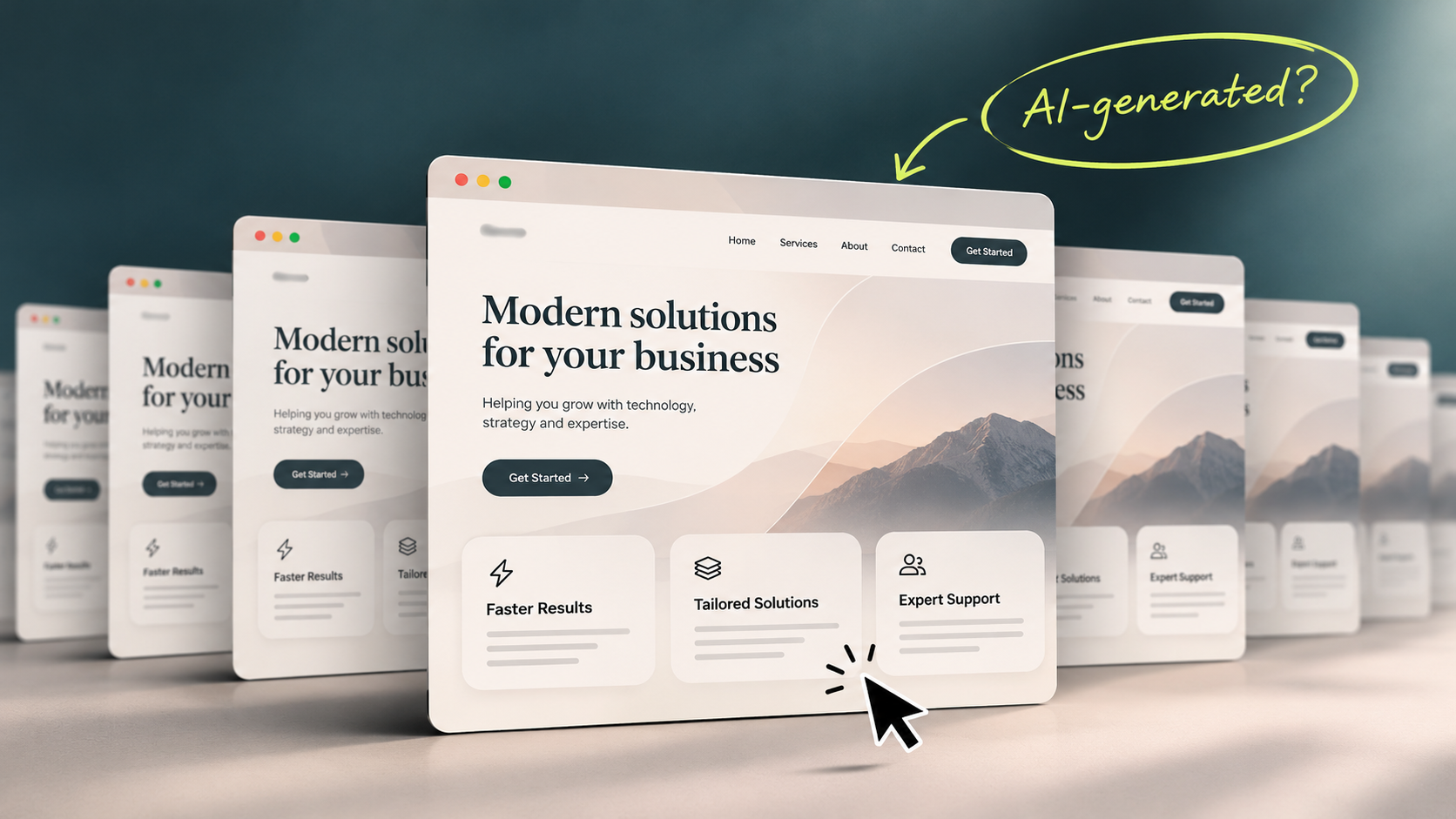
Spend a little time looking at websites created using AI tools such as Claude, ChatGPT or v0, and you might start to notice a pattern.
Soft, neutral backgrounds. Large headings. Rounded boxes. Subtle gradients. Three neatly arranged columns explaining the benefits of a product or service.
They're clean, modern and often genuinely impressive, particularly considering how quickly they can be created.
But after you've seen a few, they start to look rather familiar.
And that's an interesting problem for businesses trying to stand out.
Why do AI-generated websites look so similar?
It's not necessarily because AI is bad at design. Far from it.
The technology has advanced enormously, and it's now possible to produce a professional-looking website in a fraction of the time it would previously have taken.
The similarities have more to do with how AI generates its output, the instructions it's given and the tools it uses.
1. AI tends to play it safe
Ask an AI tool to create a "modern, professional website" and it has an enormous range of possible designs to choose from.
But without much more direction, it's likely to produce something familiar.
Large language models learn patterns from vast amounts of information, including examples of websites, code and design conventions. When given a fairly generic instruction, they often produce designs that follow established patterns.
And there's nothing inherently wrong with those patterns. They're popular for a reason.
The problem comes when thousands of businesses ask for essentially the same thing and receive remarkably similar results.
2. The tools have their own design preferences
Different AI development tools have their own approaches to generating websites.
Some favour particular styling conventions, frameworks or component libraries. Others produce layouts that reflect the examples and design patterns they've been optimised to create.
For example, modern tools frequently use frameworks and component libraries such as Tailwind CSS, shadcn/ui and Radix.
These are excellent development resources. They make it easier to create consistent, accessible and responsive interfaces.
But when the same components and styling approaches are repeatedly used without much customisation, the results can start to feel very similar.
It's a little like giving everyone the same collection of building materials and asking them to design a modern house. You'll get plenty of attractive houses, but you might also notice some recurring features.
3. Most people aren't giving AI enough direction
This is probably the biggest factor.
If you ask AI to create a website for a consultancy, it'll make assumptions about what a consultancy website should look like.
It doesn't automatically know your brand personality, what makes your business different, who your ideal customers are or what you want visitors to do.
Unless you provide that information, it has to fill in the gaps.
And that's when you start seeing the familiar layouts, generic headlines and predictable design choices.
The more specific the direction, the more distinctive the result can become.
Does it actually matter if websites look alike?
Not always.
For some businesses, a simple, professional website is exactly what's needed. If it communicates the right information, works properly and helps customers get in touch, there's no reason to make it more complicated than necessary.
And AI is making that kind of website more accessible and affordable, which is a good thing.
But there's another side to it.
If your competitors can create something that looks almost identical to your website in an afternoon, how much of a competitive advantage is your website really giving you?
For businesses operating in competitive markets, the answer matters.
Your website is often the first meaningful interaction someone has with your business. It should help them understand what you do, why you're different and why they should choose you.
A polished design is a good starting point, but it's not the whole story.
A professional-looking website isn't necessarily an effective website
This is where we think the conversation around AI website development needs to go a little further.
AI can generate an attractive design, write content, create layouts and produce functional code.
But building a successful website involves understanding the business behind it.
Who are your customers? What are they trying to achieve? What information do they need? What might prevent them from making an enquiry or completing a purchase?
And beyond the design, how does the website fit into the rest of your business?
Does it need to integrate with your CRM, ecommerce platform or internal systems? Is it accessible? Is it secure? Can you measure how effectively it's performing?
These are all things AI can help with, but they still need to be considered, implemented and tested properly.
A website can look fantastic and still fail to deliver what the business needs.
Equally, a relatively simple website can perform exceptionally well when it's been designed around the right objectives.
The difference isn't necessarily how the website was built. It's how much thought went into building the right thing.
So should businesses stop using AI to build websites?
Absolutely not.
We use AI extensively ourselves, and we're excited about what it's making possible.
It's changing the way websites and digital products are designed, developed and maintained. Tasks that once took hours can now take minutes, giving us more time to concentrate on the areas where we can add the most value.
But we see AI as a tool to improve the process, rather than a replacement for understanding the problem.
Used well, AI can help create distinctive, effective websites. It can accelerate development, support experimentation and make sophisticated functionality more accessible.
The key is knowing what to ask it to do, how to direct it and when the output needs further thought.
That means starting with a clear understanding of the business, its audience and its objectives, rather than simply asking for something that looks modern.
It also means being prepared to challenge the first result.
Just because AI can produce a website in 30 seconds doesn't mean the first version is the one you should publish.
The future of web design isn't about choosing between AI and people
We think the most interesting opportunities come from combining the two.
AI is making the technical process of creating websites faster and more accessible. That's not going away, and nor should it.
But as the technology becomes more widely available, the ability to produce a professional-looking website becomes less of a differentiator.
What matters increasingly is what that website actually does for the business.
Does it communicate something distinctive? Does it provide a better experience for customers? Does it connect the right systems, remove unnecessary work or help generate more business?
Those are the questions worth asking.
At Envious Digital, we're embracing AI as part of how we design, develop and improve digital experiences. We're also using it to help businesses automate processes, connect systems and make better use of their information.
Because ultimately, the goal isn't simply to build websites faster.
It's to build better digital solutions that help businesses achieve more.
And if your website happens to look a little different from everyone else's along the way, that's probably no bad thing.
Thinking about how AI could improve your website or digital operations?
Whether you're exploring AI-generated development, looking to improve an existing website or want to understand how AI could work within your business, we'd be happy to have a conversation.
Related Posts

 Why we have built an AI Digital Consultant